Give clients a report they can understand and a next step they can act on.
A useful client review explains the current state, shows the evidence behind it, names the next priority, and sets the point when the agency will check again.
Prospect reports and managed-client reviews serve different jobs. Make the report type, scan date, and what was reviewed easy to see.
Current stateEvidence clients can reviewOne clear next priority
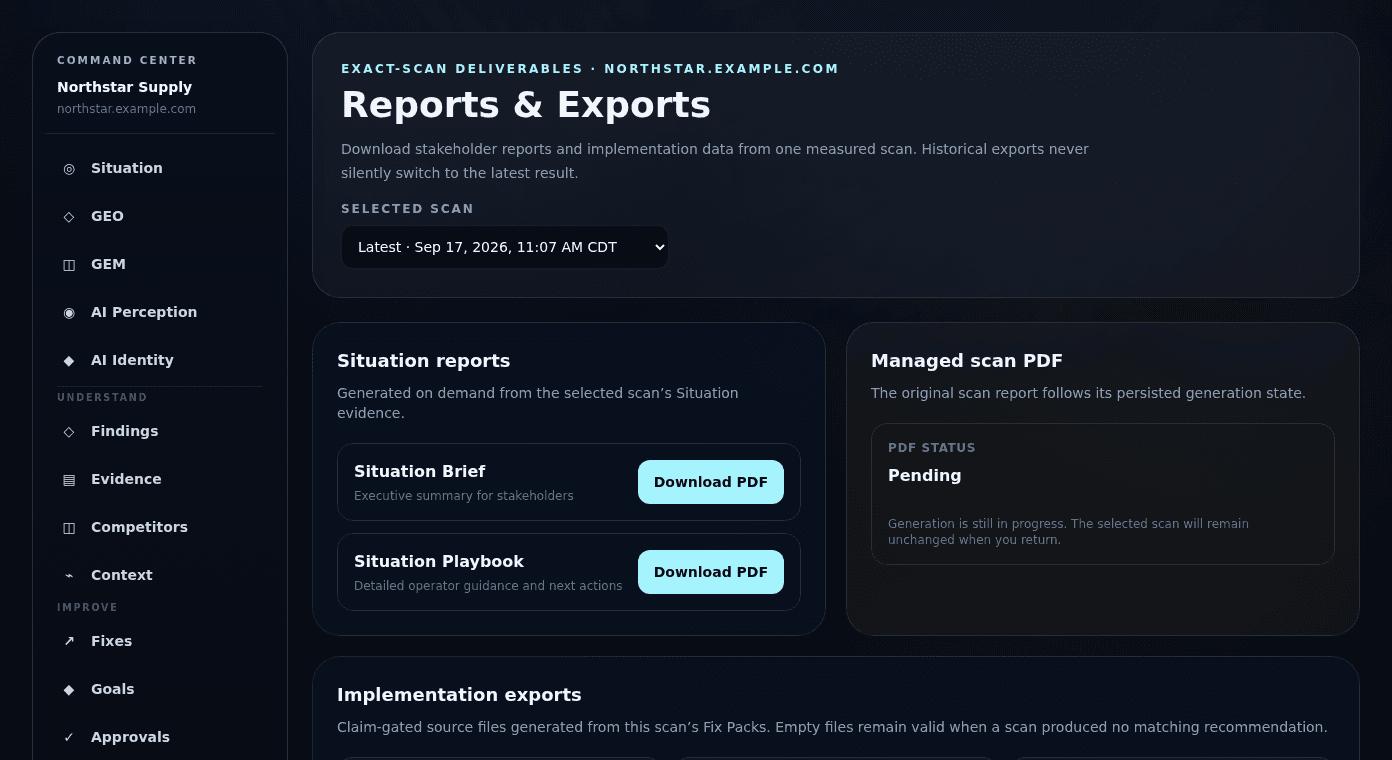
Illustrative product view
Reports and Exports gives the agency scan-specific stakeholder summaries and implementation files to use in a client review. Synthetic business shown.
A report clients can follow
Build the review around four simple questions.
Where are we now? What evidence explains it? What should we do next? When will we check again?
01
Start with the current state
Show the score or finding that sums up where things stand, along with the scan date and what the scan reviewed.
A shared starting point
02
Show the evidence
Connect the result to the website, public source, or observed AI response that helps explain it.
Evidence the client can review
03
Choose the next priority
Translate the clearest gap into approved website, content, schema, identity, or authority work.
One priority everyone understands
04
Set the next check
Agree on what should go live before the next scan and when the agency and client will review it together.
A date and reason to check again
Match the report to the relationship
A prospect report opens the door. A managed-client review guides the work.
Do not present a public Prospect Audit as though it has the deeper access and ongoing measurement of a verified client workspace.
Before the prospect becomes a client
Prospect report
Use public GEO evidence to make the first conversation specific.
Shows
Public website signals and visible GEO gaps
Helps with
Outreach, discovery, and deciding whether to pursue the opportunity
Does not include
All four AI Visibility areas, monitoring, History, or managed Fixes
After the client authorizes access
Managed-client review
Use the verified workspace to explain what Gemmetric found and what the agency recommends next.
Shows
The scores, evidence, findings, and priorities included with the client workspace
Helps with
Following up on changes and leading client reviews
Adds
Monitoring, History, and recurring reports
Make the meeting useful
Help the client understand, trust, and decide.
Better reporting is not more data. It is the right evidence in the right order, ending with an agreed next move.
Make the finding understandable
Lead with what changed and why it matters instead of dropping a client into a wall of scores.
Keep proof next to the claim
Show the evidence, source, and scan context so the client can see what the conclusion rests on.
End with a decision
Give the agency and client a clear priority, owner, and point at which to review the result again.
Agency service guides
Reporting turns won work into a clear ongoing service.
See the full path, from adding the offer and winning the client to explaining results and choosing the next priority.
Agency reporting questions
Clear boundaries make the report more credible.
What each report can cover, what the managed workspace adds, and how to discuss progress without overclaiming.
How is a Prospect Audit report different from a managed-client report?+
A Prospect Audit is a one-time public GEO review for a domain the agency does not yet manage. After the client authorizes the agency and verifies the domain, a managed-client report can use the scores, evidence, findings, Fixes, monitoring, and History included with the client workspace.
What can an agency see in a managed-client workspace?+
Agency managed-client workspaces include GEO, GEM, AI Perception, AI Identity, and the blended AI Visibility Score. Prospect Audits remain GEO-only.
Can an agency show progress over time?+
Agency managed-client workspaces include History and monitoring. Agencies can compare scan dates, evidence, scores, and resolved or continuing priorities without claiming that one change proves a permanent result.
Does a Gemmetric report guarantee rankings, mentions, or leads?+
No. Reports organize observed evidence, current results, and recommended next work. They do not guarantee search rankings, AI mentions, citations, recommendations, leads, or revenue.
Make every client review easier to act on.
See how Prospect Audits, managed-client workspaces, reporting, History, and re-scans fit together for an agency.